


The Problem: When Major Cases Require the Whole Team
H Street Law is a boutique firm that represents clients in sanctions, fraud, and financial misconduct matters — cases that live or die on the ability to move quickly and carefully through dense, messy document sets.
The work is inherently evidence-heavy: clients arrive with documents, communications, government records and other source material that the attorneys must organize, analyze and ultimately turn into a legal document.
“Prior to Weaver, it would be all-hands-on-deck. It was weeks of intense work.”
— Senior Attorney, H Street Law
Historically, a major investigation meant pulling the whole team onto one matter for weeks at a time. For a four-person firm, that could put real pressure on capacity: the most resource-intensive matter could absorb much of the team, while other matters were turned away.
Why Not Use General Purpose AI Tools?
H Street had seen the potential of AI to accelerate research and analysis through various legal platforms, but general-purpose AI tools created a massive ethical problem for work involving sensitive and privileged client information.
To use those tools responsibly, attorneys had to strip out names, dates and identifying details, reducing the matter to a sanitized hypothetical. This process removes the context that makes the facts meaningful.
“Being able to upload documents into Weaver and work with them directly is a game changer. That alone is amazing. Implementing Weaver into our investigations while continuing our investment in top level lawyers has helped us deliver more value and innovation to our clients.”
— Managing Member, H Street LawWeaver gave H Street a place to work against the actual case record rather than recreating a de-identified version of it somewhere else. For H Street, that meant AI could become a natural part of the investigative workflow rather than a separate exercise performed on fragments of the case.
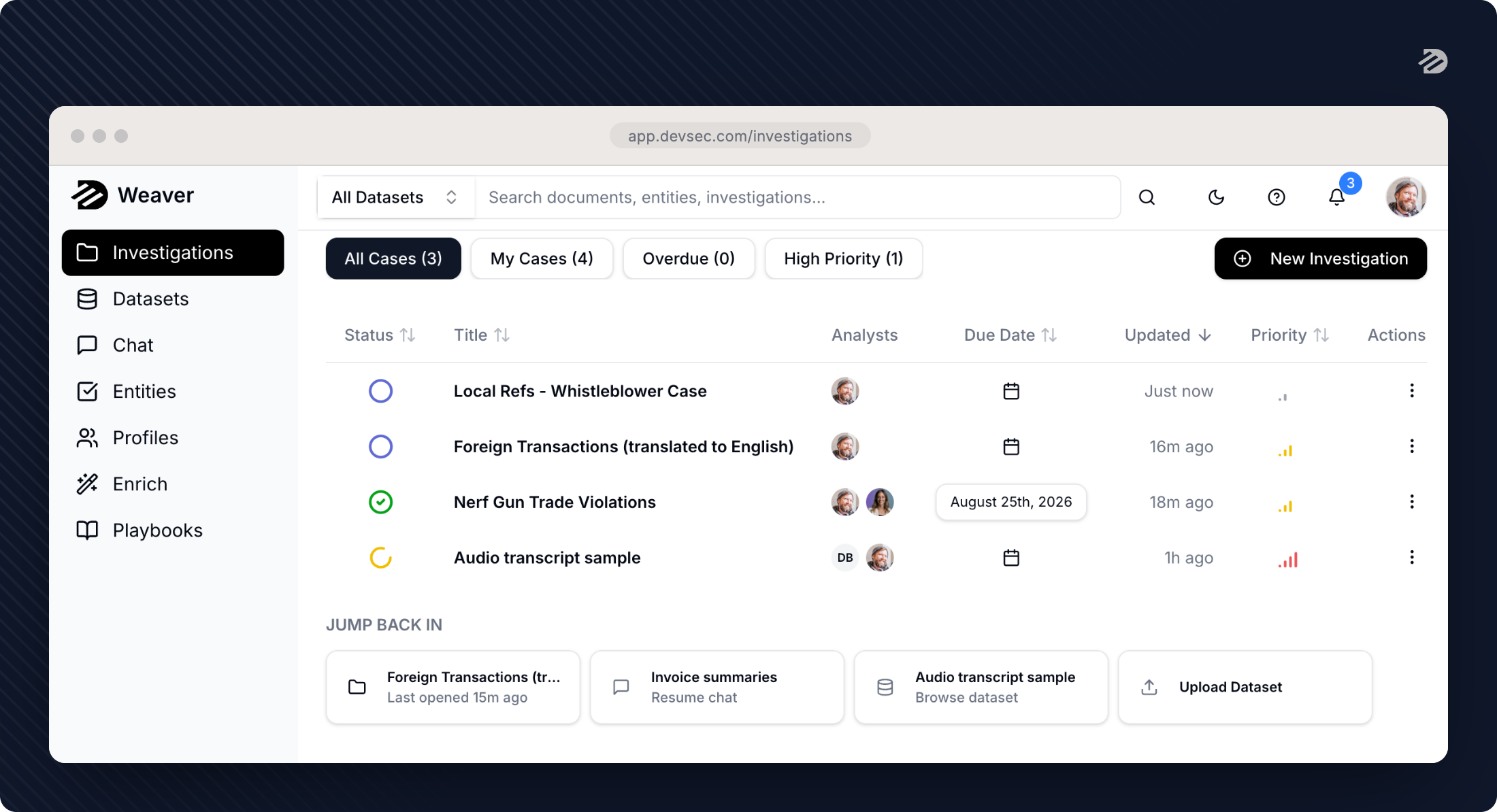
What Changed: A Compounded Workflow
The most important change was speed — not speed for its own sake, but speed that gave the firm capacity back. Timeline construction is one of the clearest examples. Building a meaningful investigative timeline across a case record could historically consume weeks of work.
The same effect shows up in H Street's investigative workflow, making data collection and query responses much easier. The closed system of Weaver also prevented the inclusion of incorrect or misleading data from unreliable sources.
“Historically it would take weeks to create a timeline. Now we can prepare one in five minutes.”
— Managing Member, H Street Law
On one matter, an attorney uploaded client evidence and extensive notes into Weaver. From there, Weaver pulled sought-after data with direct cites to the relevant evidence and notes, saving the attorney precious time. Weaver retrieved the kinds of details that can be surprisingly time-consuming to locate: company names, addresses, relevant contact information and identifiers buried in source material.
The attorney's efforts were then compounded into related documents, with the data from Weaver serving as advanced starting points for the documents that followed.
“I use Weaver to assist me in identifying data from voluminous client records. I then use Weaver to identify and pull the same data for related documents, saving me time and creating efficiencies for the clients.”
— Senior Attorney, H Street Law
That compounding effect changes the economics of a small practice. Time saved on the investigation becomes capacity for the legal work.
Beyond Speed: Expanding What the Team Can Take On
For H Street, the change has been twofold: the legal team gets time back, but it also gains room to pursue additional lines of analysis that might not have been practical within the constraints of a small firm.
One recent matter made that difference especially clear. H Street was meeting with government officials about a particular case when a recurring question came up: how does this play out in other jurisdictions?
Rather than limiting the argument to what had already been prepared, the H Street team committed to come back with jurisdiction-specific answers. With the case record already in Weaver, the attorneys could examine how the underlying conduct would be viewed in other jurisdictions and quickly surface relevant connections from the evidence — an analysis outside their initial review scope.
“In the past, I would not have said that we could do that in the time needed. But now I know we can through Weaver.”
— Managing Member, H Street Law
The bigger value was not just speed. It was creating enough capacity for the team to pursue additional questions and adjacent lines of analysis alongside the core investigation. For a four-lawyer firm, that expands what is practical within each matter: more lines of analysis can be explored without pulling time away from the rest of the practice.
The Result
The constraint was never demand — it was capacity. As the team explained, “We don't really have the luxury of hiring new people … but with Weaver we are able to ethically, responsibly and effectively increase capacity and add value for our clients.”
“Clients want the efficiency savings of AI but clients don't want AI to write their documents, nor would we trust AI to write them. You have to know what you're talking about in order to chat against any LLM. Weaver allows us to use AI effectively and carefully, and we know how to draft prompts and correct output because we have that experience.”
— Attorney, H Street LawWhat has changed is how much work the existing team can carry at once. Large investigations that once could have absorbed most of the firm can now continue while other attorneys move additional clients and documents forward in parallel.
The team estimates that it can now handle roughly 2–3x as much investigative work as it could before Weaver, without handing legal judgment over to AI.
H Street's lawyers still decide what matters, review the evidence and determine what to file to stand behind the result. The difference is how much more investigative work four experienced attorneys can move forward at the same time.